
A useful demister quotation starts with a clear duty and installation, not just a mesh photograph or model number. This checklist helps buyers prepare a replacement or new-project inquiry, compare proposals on the same basis and identify details that still need confirmation.
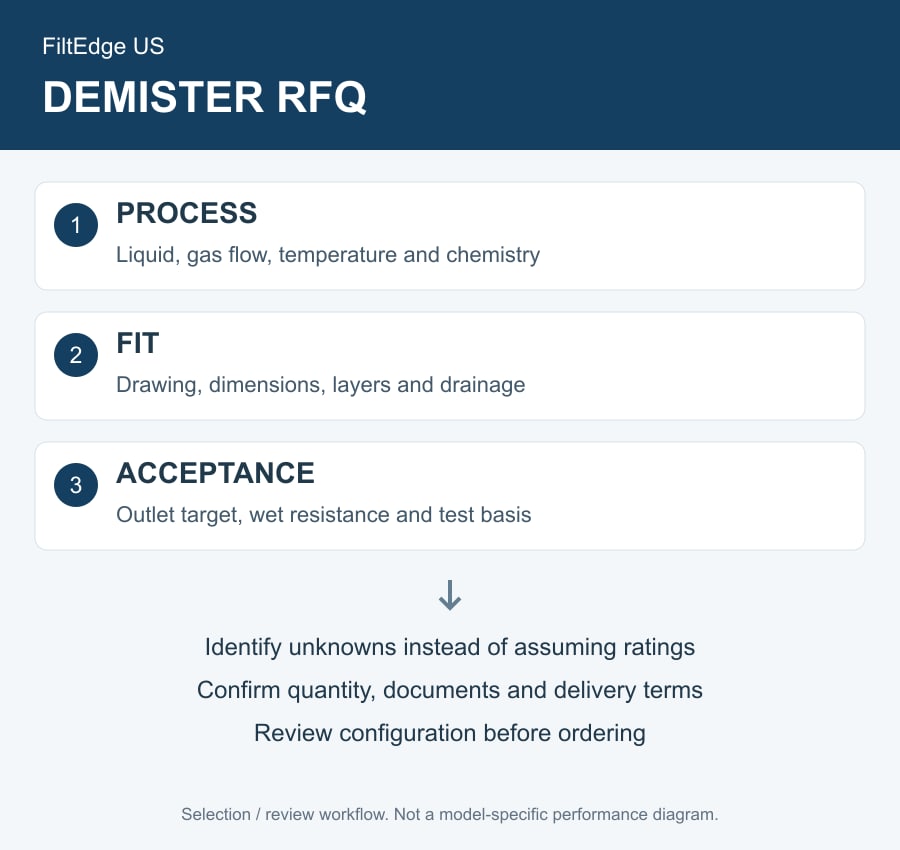
Original review workflow illustration; not a model-specific performance diagram.
1. Identify the service and separation target
Describe the process: scrubber carryover, oil mist, condensation aerosol or another gas–liquid duty. Identify the gas and liquid composition, concentration where relevant, normal and peak temperature, pressure and any solids or sticky deposits. A material listed as polypropylene is not automatically suitable for every chemical mixture or temperature.
State the required outlet liquid concentration or carryover condition, with units and a measurement basis. If droplet-size information is available, include the distribution and how it was measured. Mark missing values as unknown; a material name or filament diameter is not a droplet-removal rating.
2. State gas flow on a clear basis
Send normal, minimum and maximum flow, together with units and whether the volume is actual or standardised. Include temperature and pressure so the operating basis can be reviewed. Provide the active flow area if known. Do not compare pressure-drop or capture figures taken at unrelated flow conditions.
3. Describe the installed assembly
- Overall length, width or diameter, finished depth and dimensional tolerances.
- Existing reference, drawing revision, layer count and media arrangement.
- Frame, support grid, fixing points, seals and edge details.
- Gas-flow direction, drainage direction and access constraints.
- Photographs of the complete element, edges and installation—not only a close-up of the filaments.
For an existing separator, distinguish a like-for-like replacement from a design change. Similar appearance does not establish interchangeability. Ask what must be checked if the proposed material, layers or supports differ.
4. Read a technical reference sheet correctly
Our 3D PP monofilament demister media page lists five reference styles and downloadable technical documents. These describe reference geometry and supplier-derived information; they are not independent test certificates for every finished assembly.
Single-layer thickness is different from finished pad depth. In the FE-DM-1022 source documents, the drawing states 10 mm while the source data sheet states 8 mm. The page shows the drawing reference with this discrepancy disclosed; the final supplied thickness must be confirmed before ordering. FE-DM-5098 is outside the current five-style publication set.
5. Compare quotations using the same acceptance basis
- Capture result: required outlet condition and droplet-size basis, rather than an unqualified efficiency percentage.
- Resistance: clean and wet pressure drop at the agreed gas flow and liquid loading.
- Construction: material, layers, dimensions, frame, supports and sealing scope.
- Maintenance: cleaning compatibility, inspection access and replacement requirements.
- Documentation: drawings, material information, inspection records or application-specific test evidence required by the buyer.
Request confirmation of what is included in the quotation and what still needs engineering review. Capture and drainage are linked functions in mist separation; a loose medium is not a complete collector. [1] A fine-aerosol duty may also require a different separator design rather than a simple change of mesh. [2]
6. Confirm supply and delivery separately
Provide quantity, destination, required date and whether you need loose media, cut pieces or an assembled element. Ask for the proposed dispatch location, lead time, packaging and delivery terms in the quotation. This guide does not imply U.S. stock or immediate domestic shipment; availability and fulfilment are confirmed for the order.
Copy-ready inquiry checklist
Application: process and liquid carried in the gas
Operating conditions: gas flow and basis, temperature, pressure, chemistry and solids
Required result: outlet target, droplet information and test basis
Installation: drawing, dimensions, layers, frame, flow direction and drainage
Supply: quantity, destination, required date and document requirements
Frequently asked questions
Can I request a quotation before all data are available?
Yes. Send what you have and identify the unknowns. A preliminary review can identify missing inputs, but it is not final application approval or a guaranteed performance commitment.
Is washable PP mesh always a lower-cost option?
Compare purchase price, cleaning, downtime, inspection and verified reuse for the duty. Cleaning suitability depends on the contaminant and assembly; service life cannot be inferred from the material alone.
Can PP replace a glass-fibre bed directly?
Not from the material description alone. Review the separation target, construction, chemistry and operating evidence before evaluating a replacement.
View the PP demister references and technical downloads, then send your configuration inquiry to FiltEdge US.
Technical background
- Sulzer: KnitMesh mist eliminators—collection and drainage principles.
- Begg Cousland: A Mesh of Material Technology and Chemistry—different fibre-bed design duties.
These external references describe their authors’ technologies; they are not FiltEdge US performance certificates or statements of equivalence.