
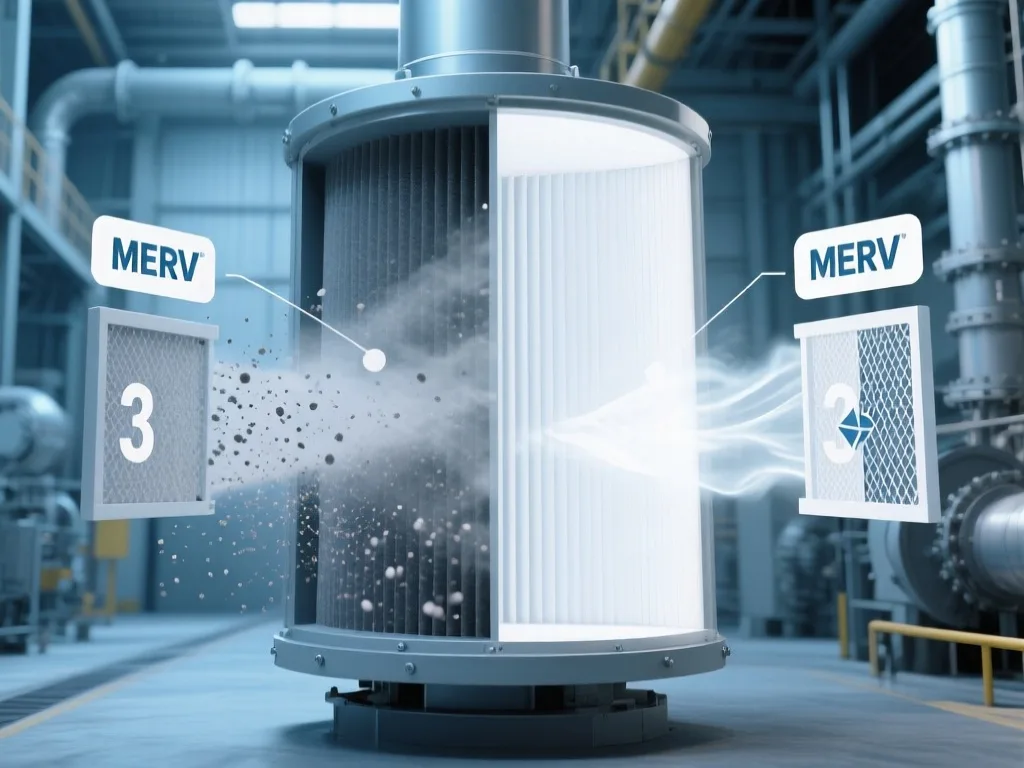
In the world of industrial filtration, understanding the efficiency of air filters is crucial for maintaining optimal air quality and system performance. But what is MERV on air filters, and why does it matter? MERV, or Minimum Efficiency Reporting Value, is a rating system that measures how effectively an air filter captures particles of different sizes. This comprehensive guide will delve into the science behind MERV ratings, explore their practical implications, and provide actionable tips for selecting the right filter for your industrial needs. Have you ever wondered how MERV ratings can transform your air filtration system?

Decoding the MERV Rating Scale: What You Need to Know
When it comes to industrial air filtration, understanding the MERV rating scale is crucial for maintaining optimal air quality and system efficiency. But what exactly is a MERV rating, and how does it impact your facility’s air filtration needs? Let’s break it down. The MERV rating, short for Minimum Efficiency Reporting Value, is a standardized scale developed by ASHRAE (American Society of Heating, Refrigerating, and Air-Conditioning Engineers) to measure the effectiveness of air filters in capturing particles of varying sizes. This scale ranges from 1 to 20, with higher numbers indicating a filter’s ability to trap smaller particles more efficiently. For more insights on the science behind MERV ratings, refer to the EPA’s guide on MERV ratings. But how are these ratings determined, and what do they mean for your industrial operations? Let’s dive deeper into the science behind MERV ratings and explore the testing methods used to assign these values.
How MERV Ratings Are Determined: The Testing Process
The process of determining a filter’s MERV rating involves rigorous testing under controlled conditions. Filters are subjected to a standardized test known as ASHRAE Standard 52.2, which measures their ability to capture particles of different sizes. During this test, a known quantity of particles is introduced into the air stream, and the filter’s performance is evaluated across three particle size ranges: E1 (0.3 to 1.0 microns), E2 (1.0 to 3.0 microns), and E3 (3.0 to 10.0 microns). These ranges represent common airborne contaminants found in industrial environments, such as dust, pollen, mold spores, and even some bacteria and viruses. The filter’s efficiency is calculated by comparing the concentration of particles before and after passing through the filter. This data is then used to determine the filter’s MERV rating, providing a clear indication of its performance across the three particle size ranges. For further reading on particle filtration theory, check out this resource.
Breaking Down the MERV Rating Scale: Particle Capture Capabilities
Now that we understand how MERV ratings are determined, let’s explore what each range on the scale captures. MERV 1-4 filters are considered low-efficiency and are typically used in residential settings or for basic dust control. These filters capture large particles like pollen, dust mites, and carpet fibers but are ineffective against smaller contaminants. Moving up the scale, MERV 5-8 filters offer moderate efficiency and are suitable for commercial buildings and some industrial applications. These filters can capture particles as small as 3.0 microns, including mold spores, pet dander, and some bacteria. For industrial environments requiring higher air quality standards, MERV 9-12 filters are often recommended. These filters excel at capturing particles in the 1.0 to 3.0-micron range, making them ideal for facilities handling sensitive materials or requiring strict contamination control. Finally, MERV 13-16 filters represent high-efficiency options commonly used in hospitals, laboratories, and cleanrooms. These filters can capture particles as small as 0.3 microns, including viruses, smoke, and even some volatile organic compounds (VOCs). At the top of the scale, MERV 17-20 filters are considered HEPA (High-Efficiency Particulate Air) filters and are used in critical environments where air purity is paramount, such as pharmaceutical manufacturing or nuclear facilities. For more information on HEPA filters, visit this page.
Real-World Implications: MERV Ratings in Industrial Settings
Understanding the MERV rating scale is one thing, but how do these ratings translate to real-world performance in industrial settings? Let’s consider a few examples. In a food processing facility, where airborne contaminants like flour dust and bacteria can pose serious health risks, a MERV 11 or higher filter might be necessary to maintain a safe and hygienic environment. Similarly, in a manufacturing plant producing electronic components, a MERV 13 filter could help prevent dust particles from settling on sensitive surfaces, reducing defects and improving product quality. On the other hand, using a filter with a MERV rating that’s too high for your needs can lead to unnecessary energy consumption and increased maintenance costs. For instance, a MERV 16 filter in a warehouse where basic dust control is sufficient would restrict airflow, forcing your HVAC system to work harder and driving up energy bills. This highlights the importance of selecting the right MERV rating for your specific industrial needs, balancing air quality requirements with operational efficiency. For a deeper understanding of air filtration basics, refer to this poster.
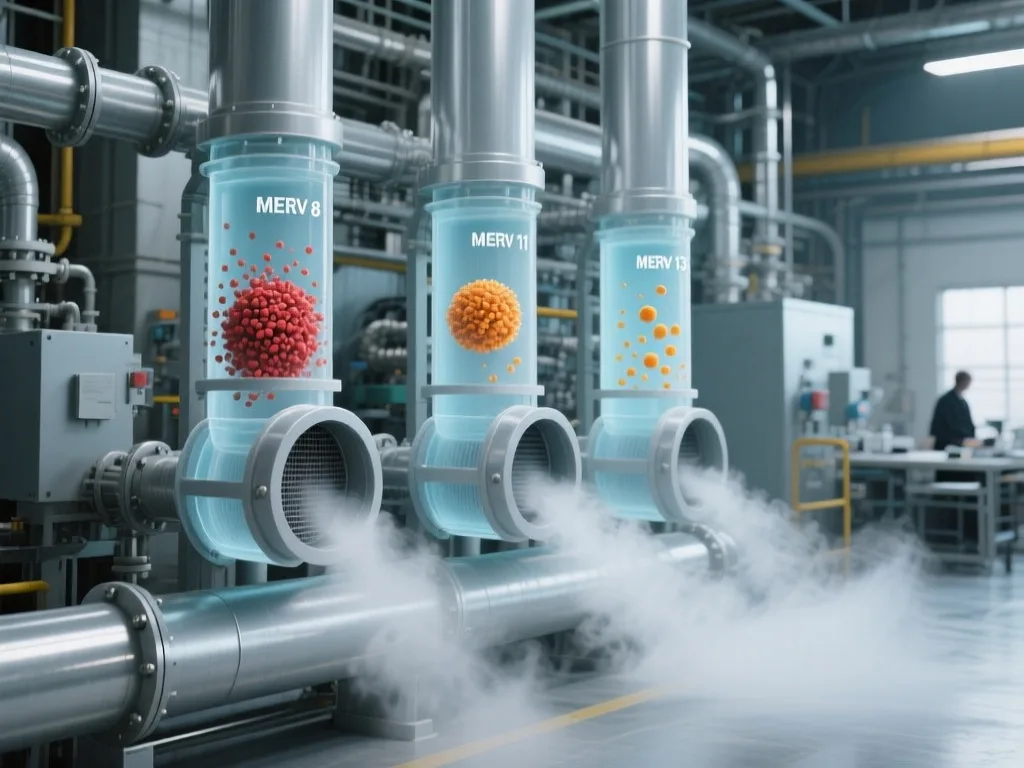
Practical Implications of MERV Ratings on Air Quality, Energy Consumption, and Filter Lifespan in Industrial Settings
When it comes to industrial air filtration, understanding the practical implications of MERV ratings is crucial for optimizing performance, efficiency, and cost-effectiveness. MERV, or Minimum Efficiency Reporting Value, is a standardized rating system that measures how effectively air filters capture particles of varying sizes. But what does this mean for your industrial facility? Let’s dive into real-world examples to see how MERV ratings impact air quality, energy consumption, and filter lifespan. First, consider air quality. In industrial environments, airborne contaminants can range from dust and pollen to more hazardous particles like asbestos fibers or volatile organic compounds (VOCs). A higher MERV rating indicates a filter’s ability to capture smaller particles, leading to cleaner air. For instance, a MERV 8 filter might be sufficient for a general manufacturing plant, capturing particles as small as 3 microns, such as mold spores and cement dust. However, in a pharmaceutical or semiconductor manufacturing facility, where even microscopic contaminants can compromise product quality, a MERV 13 or higher filter is essential, capturing particles as small as 0.3 microns, including bacteria and some viruses. Now, let’s talk about energy consumption. It’s a common misconception that higher MERV ratings always lead to increased energy use. While it’s true that denser filters can create more resistance to airflow, the impact on energy consumption depends on several factors, including the HVAC system’s design, the filter’s surface area, and the facility’s air exchange requirements. For example, a large automotive assembly plant in Detroit switched from MERV 8 to MERV 11 filters and initially saw a 5% increase in energy consumption. However, by optimizing their HVAC system’s fan speed and installing filters with a larger surface area, they reduced the energy impact to just 2% while significantly improving indoor air quality. This highlights the importance of considering the entire system when upgrading filters, rather than focusing solely on the MERV rating. For more insights on the impacts of air filters on energy consumption, refer to this research study. Filter lifespan is another critical consideration. Higher MERV filters tend to have a shorter lifespan because they capture more particles, leading to faster clogging. However, this isn’t always the case. In a food processing plant in Nebraska, managers found that MERV 13 filters lasted longer than MERV 8 filters in certain areas. Why? Because the MERV 13 filters captured more of the fine flour dust that would otherwise pass through the MERV 8 filters and accumulate on cooling coils, reducing system efficiency and causing premature filter failure. By choosing the right MERV rating for each area of the plant, they extended filter lifespans and reduced maintenance costs. These examples illustrate that selecting the appropriate MERV rating isn’t a one-size-fits-all decision. It requires a thorough understanding of your facility’s specific needs, including the types of contaminants present, the desired air quality levels, and the HVAC system’s capabilities. By carefully considering these factors, you can strike the right balance between air quality, energy efficiency, and filter lifespan, optimizing your industrial air filtration system for peak performance.
Real-World Example: Automotive Assembly Plant
In the automotive assembly plant example, the initial energy consumption increase after switching to MERV 11 filters was a concern. However, by working with HVAC experts to adjust fan speeds and select filters with a larger surface area, the plant minimized the energy impact. This demonstrates the importance of a holistic approach to filter selection, considering not just the MERV rating but also the filter’s design and how it interacts with the existing HVAC system. The plant’s experience also shows that a small increase in energy consumption can be a worthwhile trade-off for significantly improved air quality, especially in environments where employee health and product quality are top priorities. For further reading on optimizing HVAC systems for energy efficiency, you can explore this EPA report.
Real-World Example: Food Processing Plant
The food processing plant’s experience with MERV ratings highlights a common misconception: that higher MERV filters always have shorter lifespans. In this case, the opposite was true in certain areas because the MERV 13 filters prevented fine dust from accumulating on cooling coils, which would have otherwise reduced system efficiency and caused premature filter failure. This underscores the importance of evaluating the entire air filtration system, including how contaminants move through the facility and where they tend to accumulate. By choosing the right MERV rating for each area, the plant optimized both filter lifespan and system performance. For more case studies on industrial air filtration, refer to this case study.
Balancing Air Quality, Energy, and Lifespan
Achieving the right balance between air quality, energy consumption, and filter lifespan requires a nuanced understanding of your facility’s needs. Start by identifying the types of contaminants present and their concentrations. Then, consider the desired air quality levels for different areas of the facility, such as manufacturing zones versus office spaces. Next, evaluate your HVAC system’s capabilities, including fan speed, air exchange rates, and existing filter designs. Finally, work with air filtration experts to select MERV ratings that meet your air quality goals while minimizing energy impact and maximizing filter lifespan. Remember, the goal isn’t to choose the highest MERV rating possible but to find the optimal rating for your specific needs. For more information on air quality standards and MERV ratings, you can refer to this scientific article.

Step-by-Step Guide: Selecting the Right MERV Rating for Industrial Needs
Choosing the right MERV rating for your industrial air filters isn’t just about picking a number—it’s about aligning filtration efficiency with your facility’s unique demands. Let’s break down the process into actionable steps, considering factors like facility size, occupancy, and airborne contaminants. By the end, you’ll have a clear roadmap to optimize air quality without overspending on energy or maintenance. For a deeper understanding of MERV ratings and their implications, refer to the EPA’s guide on what is a MERV rating.
Step 1: Assess Facility Size and Layout
Start by measuring your facility’s square footage and ceiling height. Larger volumes of air require filters with higher particle-capture efficiency to maintain cleanliness. For example, a 50,000-square-foot warehouse with 20-foot ceilings will need more robust filtration than a 5,000-square-foot office with 10-foot ceilings. Use a MERV rating chart to compare options—MERV 8 filters capture 70–85% of particles ≥3 microns, while MERV 13 filters trap 90%+ of particles ≥1 micron. Choose a rating that matches your space’s airflow and contamination levels without overloading the HVAC system.
Step 2: Evaluate Occupancy and Activity Level
Human activity directly impacts air quality. High-occupancy areas like call centers or classrooms generate more CO2, dust, and allergens, requiring stricter filtration. A MERV 11 filter is often recommended for spaces with 20+ occupants, as it captures 85%+ of particles ≥1 micron, including pollen and pet dander. For industrial settings with heavy machinery or chemical use, prioritize MERV 13–16 filters to remove hazardous particles like silica dust or welding fumes. Always align your MERV rating with OSHA or ASHRAE guidelines for your industry. For more insights on MERV ratings in industrial settings, see How to Understand MERV Ratings and Industrial Dust Collector Filtration.
Step 3: Identify Airborne Contaminants
Different industries face unique airborne threats. An automotive paint shop deals with VOCs and paint overspray, while a bakery must control flour dust and mold spores. Use a particle counter or air quality monitor to identify contaminants’ size and concentration. For example, if your facility has high levels of PM2.5 (particles ≤2.5 microns), choose a MERV 13+ filter, as lower ratings won’t capture these fine pollutants effectively. Consult industry-specific resources like the EPA’s ‘Indoor Air Quality Tools for Schools’ program for tailored advice.
Step 4: Check HVAC System Compatibility
Your HVAC system’s design limits the maximum MERV rating it can handle. Older or undersized units may struggle with high-efficiency filters, leading to reduced airflow and increased energy use. Check your system’s manual or consult a technician to determine its ‘static pressure’ capacity—the resistance filters create as air passes through. MERV 8 filters typically add 0.1–0.2 inches of water column (in. WC) pressure, while MERV 16 filters can add 0.5+ in. WC. Ensure your system can handle the pressure without overheating or cycling on/off frequently.
Step 5: Balance Cost and Maintenance
Higher MERV ratings come with higher costs—both upfront and long-term. A MERV 16 filter might cost 2–3x more than a MERV 8 filter and require monthly replacements instead of quarterly. Calculate the total cost of ownership (TCO) by factoring in filter price, energy consumption (higher MERV = more energy), and labor for changes. For example, a MERV 13 filter in a 10,000-square-foot facility might cost $150/month in filters + $50/month in extra energy vs. $50/month for MERV 8 filters + $20/month in energy. Choose the option that offers the best ROI without compromising air quality.
Now that you understand what is MERV on air filters, you’re equipped to make informed decisions about your industrial air filtration systems. From improving air quality to optimizing energy consumption, MERV ratings play a pivotal role in ensuring your facility operates efficiently and safely. Assess your current air filters, consider your specific industrial needs, and choose a MERV rating that aligns with your goals. For further guidance, download our free MERV rating selection checklist or schedule a consultation with our experts. How will you leverage MERV ratings to enhance your air filtration strategy?