

When it comes to maintaining clean and healthy indoor air, understanding what is MERV rating for air filters is essential. MERV ratings provide a standardized way to measure a filter’s ability to capture particles of varying sizes, ensuring you choose the right filter for your specific needs. But what exactly do these numbers mean, and how can they guide your purchasing decisions? This guide will demystify the MERV rating scale, explore its applications across different settings, and highlight the benefits of selecting the right MERV-rated filter for your space. Ready to breathe easier? Let’s dive in.

Decoding the MERV Rating Scale: What It Means for Air Filter Efficiency
When it comes to choosing the right air filter for your home, office, or industrial facility, understanding the MERV rating scale is crucial. But what exactly is a MERV rating, and how does it determine the efficiency of an air filter? Let’s break it down in a way that’s easy to understand, so you can make informed decisions about your air quality needs. The MERV rating, which stands for Minimum Efficiency Reporting Value, is a standardized system used to measure the effectiveness of air filters in capturing particles of different sizes. Developed by the American Society of Heating, Refrigerating, and Air-Conditioning Engineers (ASHRAE), the MERV scale ranges from 1 to 20, with higher numbers indicating better filtration capabilities. For a more detailed explanation, you can refer to the official EPA guide on what is a MERV rating. So, how are these ratings determined? The process involves testing air filters under controlled conditions to see how well they capture particles of varying sizes, from large dust particles to microscopic allergens and even bacteria. The results are then used to assign a MERV rating, giving you a clear indication of the filter’s performance.
How MERV Ratings Are Determined
To understand how MERV ratings are determined, it’s helpful to visualize the testing process. Imagine a controlled environment where air containing a specific mix of particles is passed through the filter. The particles are categorized by size, ranging from 0.3 to 10 micrometers (µm). These sizes represent common pollutants like dust, pollen, mold spores, and even some bacteria. During the test, the filter’s ability to capture particles at each size range is measured and recorded. The efficiency is calculated as the percentage of particles captured at each size point. The lowest efficiency value across all particle sizes determines the filter’s MERV rating. For example, if a filter captures 80% of particles sized 3-10 µm but only 20% of particles sized 0.3-1 µm, its MERV rating would be based on the lower efficiency (20%) for the smallest particles. This ensures that the MERV rating reflects the filter’s worst-case performance, giving you a realistic expectation of its capabilities. For further reading, check out the Wikipedia page on Minimum Efficiency Reporting Value.
Visualizing MERV Ratings with a Chart
To make this clearer, let’s look at a simplified MERV rating chart:
As you can see, filters with higher MERV ratings are designed to capture smaller particles with greater efficiency. This means that a MERV 13 filter, for example, is much better at trapping allergens and bacteria than a MERV 4 filter. But why does this matter? Because the particles that affect air quality the most are often the smallest ones. Dust and pollen are visible to the naked eye, but allergens like mold spores and pet dander are microscopic. A high-MERV filter can capture these tiny particles, significantly improving the air you breathe.
What MERV Ratings Indicate About Filter Efficiency
Now that you know how MERV ratings are determined, let’s explore what they indicate about filter efficiency. In simple terms, a higher MERV rating means the filter can trap more and smaller particles, leading to cleaner air. However, it’s important to note that higher MERV ratings also come with trade-offs. Filters with MERV ratings of 13 or higher are often referred to as ‘high-efficiency’ filters. They’re excellent at capturing allergens, bacteria, and even some viruses, making them ideal for hospitals, laboratories, and homes with allergy sufferers. But these filters also have denser material, which can restrict airflow if your HVAC system isn’t designed to handle them. On the other hand, lower MERV ratings (1-8) are suitable for basic dust and pollen filtration. They’re less restrictive, making them a good choice for older HVAC systems or environments where airflow is a priority. However, they won’t do much to improve air quality for those with allergies or respiratory issues. So, how do you choose the right MERV rating for your needs? It depends on several factors, including your HVAC system’s capabilities, the specific air quality concerns in your environment, and your budget. A MERV 8 filter might be sufficient for a typical home, but if you have pets, allergies, or live in an area with high pollution, a MERV 11 or 13 filter could be a better choice.
MERV Rating Levels and Their Applications
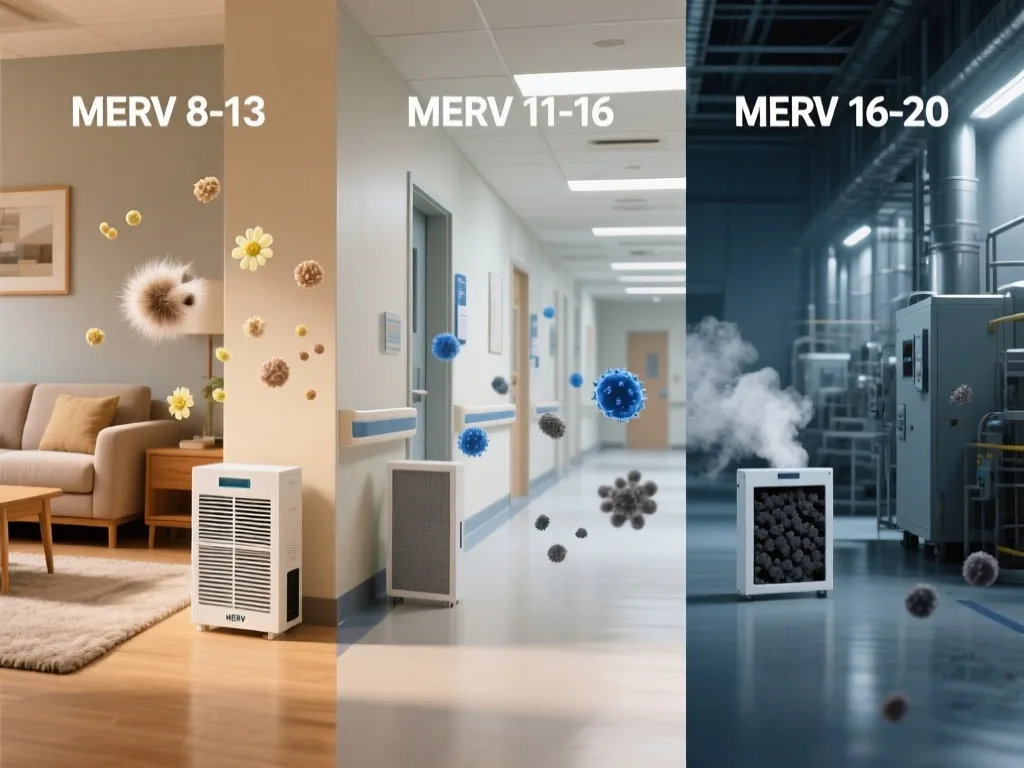
When it comes to selecting the right air filter for your specific needs, understanding the different MERV rating levels and their corresponding applications is crucial. The MERV rating scale ranges from 1 to 20, with higher numbers indicating better filtration efficiency. However, not every setting requires the highest MERV rating available. Let’s delve into how different MERV ratings are applied across residential, commercial, and industrial settings, providing you with real-world examples to guide your decision-making process. For a more detailed explanation of MERV ratings, you can visit EPA’s guide on MERV ratings.
Residential Applications
For homeowners, choosing the right MERV rating can significantly impact indoor air quality and overall comfort. Typically, residential settings benefit from MERV ratings between 8 and 13. Filters with a MERV 8 rating are effective at capturing larger particles like dust, pollen, and mold spores, making them suitable for general household use. If you or your family members suffer from allergies, upgrading to a MERV 11 filter can provide better protection by trapping smaller particles such as pet dander and some bacteria. For those seeking even greater filtration, a MERV 13 filter can capture fine particles like smoke and some viruses, offering superior air quality. Real-world example: A family living in a suburban area with pets might opt for a MERV 11 filter to reduce allergens and improve overall air quality.
Commercial Applications
Commercial buildings, such as offices, retail stores, and hospitals, have varying air quality needs based on their occupancy and activities. Generally, commercial settings require MERV ratings between 11 and 16. Offices and retail stores often use MERV 11 to 13 filters to maintain a clean and comfortable environment for employees and customers. Hospitals and healthcare facilities, on the other hand, need higher filtration efficiency to prevent the spread of airborne pathogens. MERV 14 to 16 filters are commonly used in these settings to capture fine particles and microorganisms effectively. Real-world example: A hospital might implement MERV 16 filters in its operating rooms and intensive care units to ensure the highest level of air purity and patient safety. To learn more about MERV ratings in commercial settings, you can refer to Designing Buildings Wiki’s article on MERV.
Industrial Applications
Industrial environments, such as factories, manufacturing plants, and power stations, face unique air quality challenges due to the presence of large amounts of dust, chemicals, and other pollutants. These settings typically require MERV ratings between 16 and 20 to handle the demanding filtration needs. MERV 16 filters are effective at capturing fine particles and can be used in various industrial applications. For more critical environments, MERV 17 to 20 filters provide the highest level of filtration, capturing even the smallest particles and ensuring clean air for workers and equipment. Real-world example: A semiconductor manufacturing plant might use MERV 20 filters in its cleanrooms to maintain an ultra-clean environment necessary for producing sensitive electronic components.
Choosing the Right MERV Rating
Selecting the appropriate MERV rating for your specific setting involves considering several factors, including the type of pollutants present, the desired level of air quality, and the capabilities of your HVAC system. Higher MERV ratings offer better filtration but can also restrict airflow if your system isn’t designed to handle them. It’s essential to strike a balance between filtration efficiency and system performance to ensure optimal results. Real-world tip: Consult with an HVAC professional to assess your system’s capabilities and determine the best MERV rating for your needs.
Explore the Benefits of Using Air Filters with Higher MERV Ratings
When it comes to maintaining a healthy indoor environment, the quality of the air you breathe is paramount. One of the most effective ways to ensure clean air is by using air filters with higher MERV ratings. But what exactly are the benefits of opting for these advanced filters? Let’s dive into the details and uncover how higher MERV ratings can make a significant difference in your home or workspace.
Improved Air Quality
One of the primary benefits of using air filters with higher MERV ratings is the substantial improvement in air quality. MERV, which stands for Minimum Efficiency Reporting Value, is a scale that measures how effectively an air filter captures particles of different sizes. Higher MERV ratings indicate that the filter can trap smaller particles, including dust, pollen, pet dander, and even some bacteria and viruses. This means that the air circulating in your space will be cleaner and fresher, reducing the risk of respiratory issues and allergies. For a more in-depth understanding of MERV ratings, you can refer to the EPA’s guide on MERV ratings. Imagine walking into a room and immediately feeling the difference in the air—it’s lighter, fresher, and free from the irritants that can trigger sneezing or coughing fits. That’s the power of a high MERV-rated filter.
Reduced Allergens
For allergy sufferers, the benefits of higher MERV-rated filters are even more pronounced. Allergens like pollen, mold spores, and dust mites are common triggers for allergic reactions, ranging from mild discomfort to severe respiratory distress. By using an air filter with a MERV rating of 11 or higher, you can significantly reduce the concentration of these allergens in the air. This is particularly important during peak allergy seasons when outdoor pollen levels are high. A high MERV filter acts as a barrier, preventing these allergens from entering your living space and providing much-needed relief for those with allergies. It’s like having a personal shield against the invisible enemies that can make your life miserable.
Potential Health Benefits
Beyond improving air quality and reducing allergens, higher MERV-rated filters can also offer potential health benefits. By capturing smaller particles, these filters can help reduce the spread of airborne illnesses, such as the flu or common cold. This is especially crucial in shared spaces like offices, schools, and healthcare facilities, where the risk of cross-contamination is high. Additionally, cleaner air can contribute to better overall health, reducing the likelihood of developing chronic respiratory conditions over time. Think of it as an investment in your long-term well-being—a small change that can have a big impact on your quality of life.
Addressing Common Misconceptions
Despite the numerous benefits, there are still some common misconceptions surrounding higher MERV-rated filters. One of the most prevalent is the belief that these filters can restrict airflow, leading to reduced HVAC efficiency and higher energy bills. While it’s true that some high MERV filters can have a slight impact on airflow, this is often mitigated by choosing the right filter for your specific HVAC system. Modern filters are designed to balance filtration efficiency with airflow, ensuring optimal performance without compromising energy efficiency. Another misconception is that higher MERV filters need to be replaced more frequently. In reality, the lifespan of a filter depends on various factors, including the level of pollutants in the air and the frequency of use. Many high MERV filters are designed to last just as long as their lower-rated counterparts, providing long-lasting protection without the need for frequent replacements. For more information on MERV ratings and their impact on airflow, you can visit Grainger’s guide on MERV ratings and air filter charts.
Choosing the Right MERV Rating for Your Needs
Selecting the right MERV rating for your air filter depends on several factors, including the specific needs of your space, the type of HVAC system you have, and your budget. For most residential settings, a MERV rating between 8 and 13 is sufficient to capture a wide range of particles and improve air quality. However, if you have allergies or respiratory conditions, or if you live in an area with high levels of outdoor pollution, a higher MERV rating may be more appropriate. Commercial and industrial settings, on the other hand, may require even higher MERV ratings to meet specific air quality standards and regulatory requirements. It’s always a good idea to consult with an HVAC professional to determine the best MERV rating for your specific needs and ensure that your system is compatible with the chosen filter.
Now that you understand what is MERV rating for air filters, you’re equipped to make informed decisions about the filters you use in your home, office, or industrial facility. From improving air quality and reducing allergens to enhancing overall health, the right MERV-rated filter can make a significant difference. Remember to assess your specific needs based on the MERV rating guide provided and consider factors like filter lifespan and maintenance requirements. For more information on selecting the perfect air filter, explore our related resources or browse our range of high-quality MERV-rated filters today. What MERV rating will you choose for your next filter upgrade?